Freedom without structure is escapism: The employee to entrepreneur loop

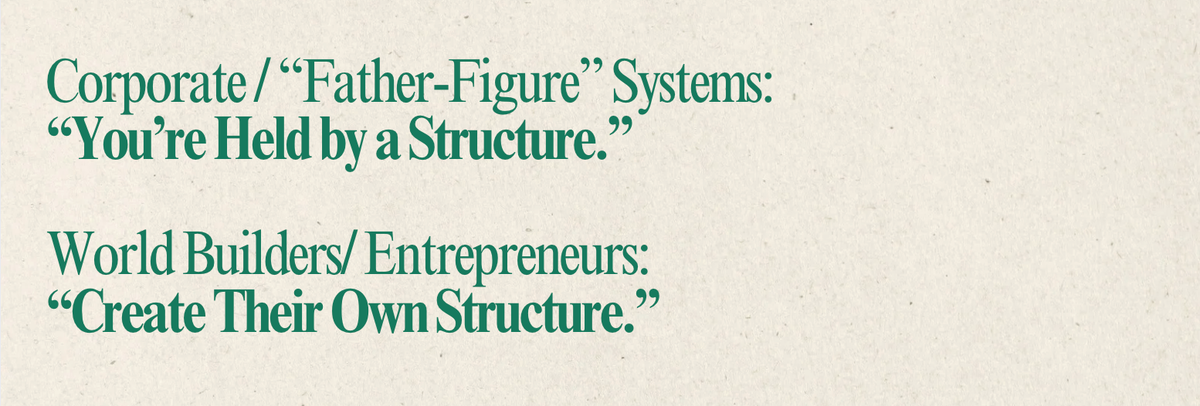
This is for anyone who went from employee to entrepreneur and didn't realise your salary isn’t the only thing you need to replace when you leave your job.
In 2021, I received a well timed synchronous email from an old boss asking if I would come work for her.
At the time, I was living in Ireland with my mum and dad. It was peak lockdown. I was working remotely for a tech company in London and had convinced my dad to help me convert a Renault Trafic van into a camper in the driveway of my childhood home.
My vision was to drive around Europe and continue working remotely but the tech company I worked for said I needed to come back to London when the lockdowns lifted.
The issue with this was that I could see the camper taking shape in my parents' driveway. Every week it looked more real, and the more real it looked, the more I could taste the freedom, and the less I wanted to go back to London.

The email from my old boss was a well timed, synchronous message that sparked the idea of going out on my own as a contractor. Instead of interviewing for the full-time role, I suggested working on a project basis, she liked the idea.
For the next three years, I continued to sell similar work and managed to increase my income by 30%, while taking minimum 2 - 3 months off each year. I travelled around in my camper, rotating between staying in the van and living in nice Airbnbs across Europe or Ireland. It was amazing.
I got exactly what I wanted: more money, more time, more autonomy. But, because I was so focused on the freedom, I missed the fine print: no one was managing me anymore.
For the first time ever in my life, there was no one managing me. No parent, no teacher, no boss. No one telling me what “good” looked like. No boss telling me what to do. No promotion cycle and no one setting my direction. I had unknowingly signed up to become my own manager.
The moment nobody was “in charge” of me, I had all the freedom I wanted, but I didn’t yet realise that the job I had just left was actually doing a lot of important work for me in the background.
I tried to avoid negative feedback at all costs, because I couldn't handle it. so I would spend longer on things than necessary. I questioned my abilities more than I needed to. And I would sometimes find myself looking for permission to be in the rooms I was already in — and when it didn’t come (because that’s not anyone else’s job), I started inventing reasons why I might not belong there.
Since then, I’ve worked with so many founders and business owners who unknowingly signed up for the same role. Most of them are everyone else’s biggest hype person, but privately their own worst boss — trying to recreate the structure their job once gave them in order to feel stable, without even realising there was a structure there in the first place.
If your salary isn’t the only thing you need to replace when you leave your job... what do you need to replace? 5 years later, this is what I've found
Entrepreneurship removes what I’ll call the “Father Structure”, it's hard to see, which means it's hard to recreate.
In psychology and spiritual symbolism, the “father” archetype represents structure, direction, boundaries, and consequences - not as control, but as the stability that holds everything else.
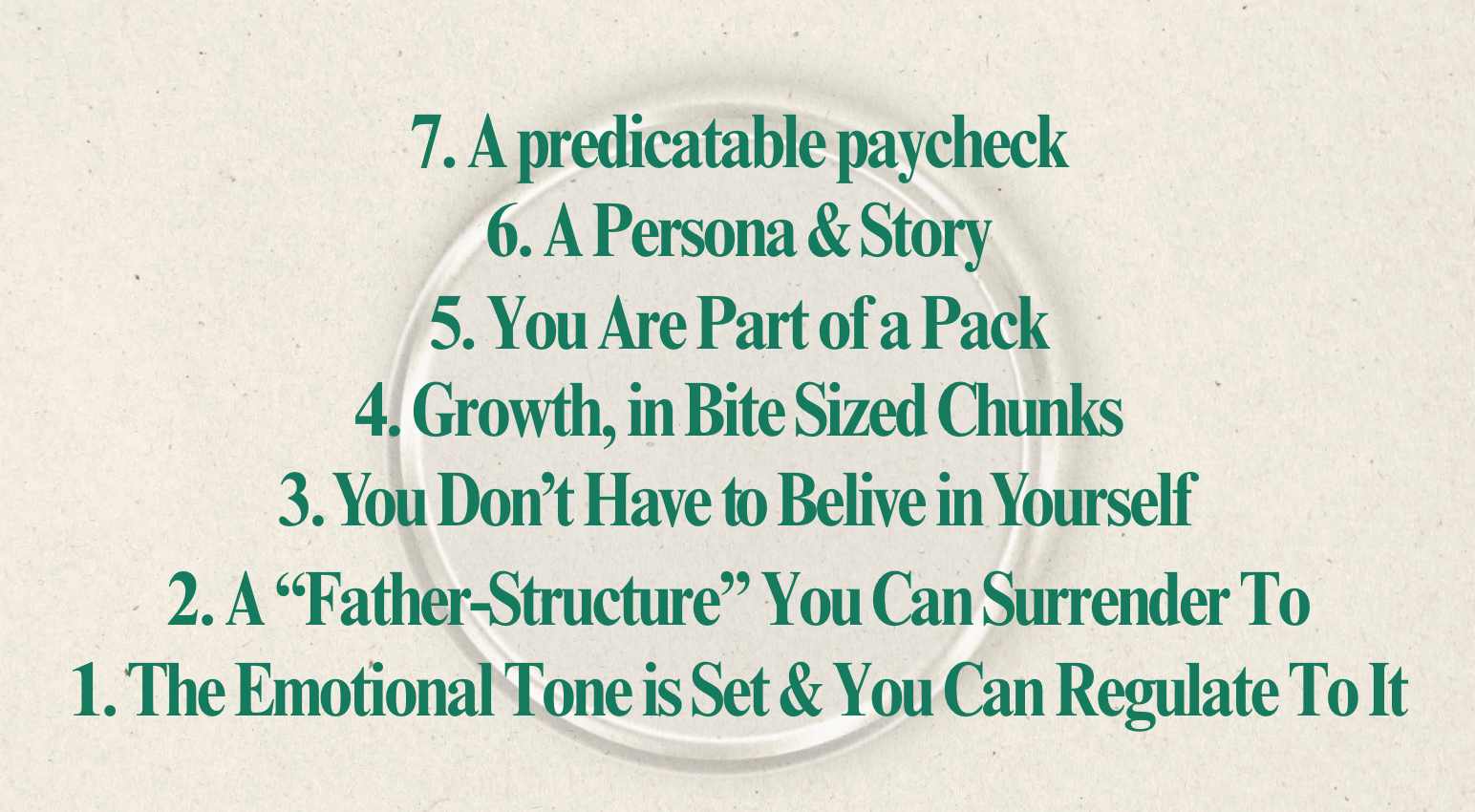
Most people I know start their own business for more freedom, but freedom without structure is just escapism. I have tested the edges of this, and below is what I’ve learned are non-negotiables in making the transition from employee to starting your own thing.
This is not a list to check off, think of it more like skills and qualities you develop over a 1 - 3 year period. I'll go deeper on some of these in another article.
#1. Setting the emotional tone
What you lose: Someone else sets the emotional tone for your day
What to build instead: Generate your own emotional state
When you’re an employee, you react to the emotional state of the person with the most intense presence (which is usually the person with the most authority).
If the manager is stressed, you’ll react to that. If the manager is in a good mood, you’re going to calm down. Even if the emotional tone is chaotic, you are not responsible for generating it, you react to it.
When you leave, you are responsible for generating your own emotional state. State = your emotions, your reactions, your ability to hold responsibility and take things in your stride.
#2. Rules and standards to contain your brilliance
What you lose: Direction, standards, consequences, and rules
What to build instead: New rules that better suits your needs
There was an experiment done with children in a playground. When there was a fence around the playground, the kids played all the way to the edges. When the fence was removed, they didn’t go near the boundaries, they clustered near the building. Nothing about the playground changed, but without clear boundaries they didn’t feel safe enough to explore the space fully.
As someone who hates structure, I keep learning the hard way that structure doesn’t limit freedom. It creates the conditions where freedom is possible.
#3. You don’t have to believe in yourself
What you lose: Someone else tells you you’re doing a good job
What to build instead: Your own feedback loops & (eventually) self belief
Managers, promotion cycles, quarterly reviews. You’re getting enough validation from others so you don’t ever have to cultivate belief in yourself, which is exactly what you need when you're building something on your own.
#4. Growth in bitesized chunks
What you lose: a predictable growth path, promotion cycles
What you build: your own trajectory
My business grew really fast at the start, and then it plateaued for 2 years, then I took a dip in income year 3, and I interpreted that as failure. I gave myself such a hard time about it. In hindsight it wasn't a failure at all, I also had 3 months off... got to train in a new modality... basically, growth tends not to be linear and you have to shift what you measure. More coming on this too.
#5. You’re part of a pack
What you lose: People who would notice if you don’t show up
What to build instead: Find your own people
Having a shared email address, someone noticing you’re missing from a meeting, being easy to find you on Slack. You need to replace this with other people who are building and in the same boat as you, either find a community to join, or create your own.
#6. A persona and a story
What you lose: Someone else tells you who you are and what your story means
What you replace it with: your own, ever evolving narrative
“It’s easier to play a role in a game you didn’t create” (Alan Watts). Your title tells you who you are. Your assigned responsibilities tell you what people need from you. Your team gives you a context on why you exist. The role comes with lore, who was there before, why you’re a fit now, other people tell you a story.
When you go out on your own, you need to write your own role in society. Who needs you? Why is that important? Why should people care? Why do you care? Write your story, it will help you.
#7. A regular paycheck
What you lose: someone else is responsible for your monthly paycheck
What you build: a predictable income stream
This one is the obvious, if you aren't doing this then you don't have a business. One of the most exciting parts of running your own business is the potential of what you can earn is endless, AND I have found it becomes a lot easier when all of the above is in order.
P.S. In April, I'm hosting a 12 week, online artist residency for World Builders. Reply to this email with "RESIDENCY" if you want me to send you the invite.
Or you are always welcome to DM me on Instagram if you have questions about the article or the residency.